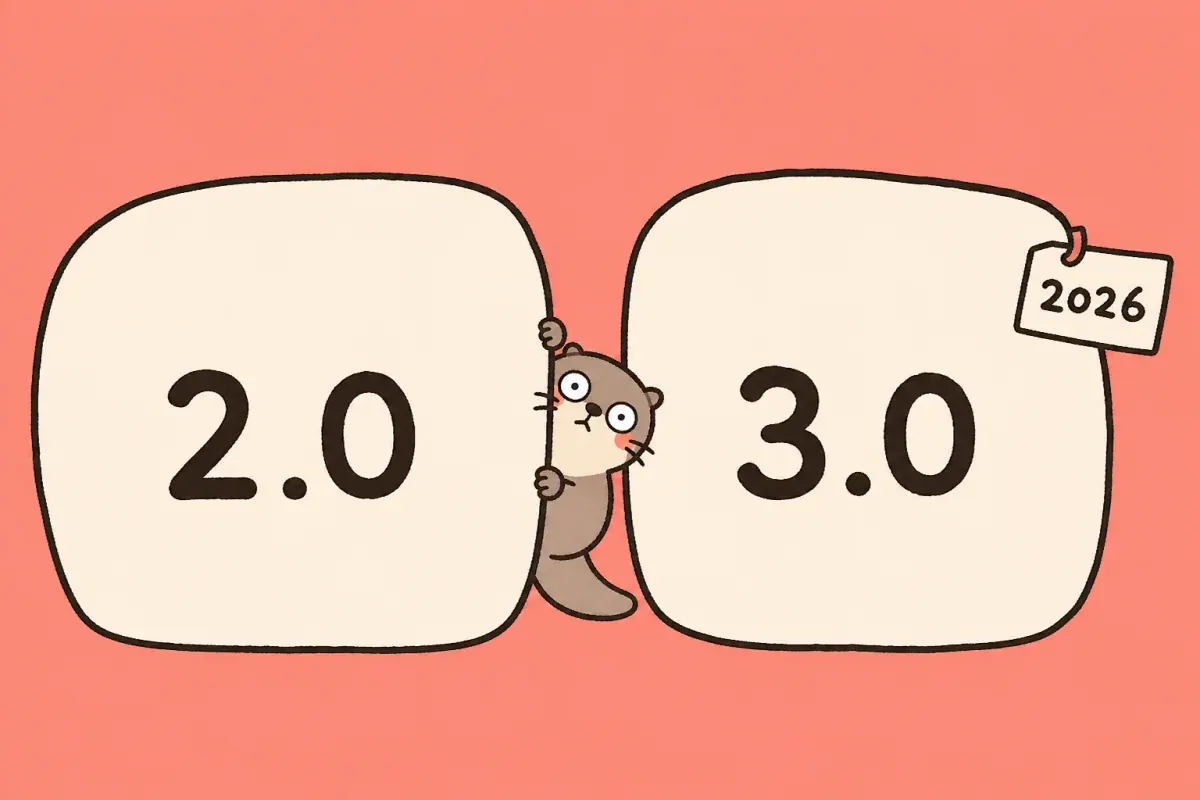
Yes—HSK 3.0 is generally more demanding if you compare the same numbered level, especially from Levels 1 through 5. The current official syllabus lists 1,000 words by Level 3 instead of the old HSK 3 target of 600, for example. It also defines what candidates should do across tasks, topics, grammar, characters, and productive skills rather than treating a vocabulary list as the whole level.
But “new HSK 3 versus old HSK 3” is not a clean equivalence. HSK 3.0 redraws the complete ladder from six levels to three stages and nine levels. The number on the certificate stayed familiar while the scale behind it changed.
Is HSK 3.0 harder at the same numbered level?
For Levels 1–5, the clearest numerical answer is yes. The official November 2025 HSK 3.0 exam syllabus contains cumulative vocabulary lists of 300, 500, 1,000, 2,000, 3,600, and 5,400 entries for Levels 1–6. The official description of the previous six-level HSK gives 150, 300, 600, 1,200, 2,500, and at least 5,000.
| Same-number label | Previous HSK | HSK 3.0 syllabus | Numerical increase |
|---|---|---|---|
| Level 1 | 150 words | 300 words | 100% |
| Level 2 | 300 words | 500 words | 67% |
| Level 3 | 600 words | 1,000 words | 67% |
| Level 4 | 1,200 words | 2,000 words | 67% |
| Level 5 | 2,500 words | 3,600 words | 44% |
| Level 6 | 5,000+ words | 5,400 words | about 8% versus 5,000 |
These are syllabus-list totals, not a promise that memorizing exactly that many flashcards produces a passing score. They are still useful evidence: the early and middle same-numbered levels now cover a visibly larger lexical range.
Why is a same-number comparison misleading?
Because the top of the system moved. The previous HSK ended at Level 6. HSK 3.0 continues through Levels 7–9, with the current syllabus reaching 11,000 vocabulary entries across the advanced band.
The official HSK overview describes the new structure as “three stages, nine levels” and says it assesses listening, speaking, reading, writing, and—at advanced levels—translation. The Ministry of Education’s 2021 proficiency standard likewise treats the framework as a description of communicative ability, tasks, language knowledge, and five skills.
So old HSK 6 and new HSK 6 do not occupy the same endpoint. The new Level 6 can list only 8% more vocabulary than the old minimum while still sitting below a new advanced tier. “Eight percent more words” is not the same claim as “eight percent harder.”
Why do HSK 3.0 vocabulary numbers online disagree?
Many pages are comparing different official documents. The 2021 proficiency standard and the November 2025 exam syllabus are not identical lists.
For example, an older chart may say Level 1 requires 500 words or Level 3 requires 2,245. Those figures come from the 2021 grading standard often discussed when HSK 3.0 was first announced. The current exam syllabus instead numbers its Level 1 list through 300 and its Level 3 list through 1,000.
Use this quick date check:
- 2021 standard: the broad proficiency framework that established three stages and nine levels.
- November 2025 exam syllabus: the current 406-page HSK testing syllabus, marked for implementation in July 2026.
- 2026 trial notices and registration: the source for actual trial dates, required companion speaking tests, duration, and registration rules.
The newer syllabus does not make the earlier standard fake. It means a framework and an operational exam specification serve different jobs. For exam preparation, the document attached to your actual sitting matters most.
Does HSK 3.0 test more than vocabulary?
Yes. The new syllabus is organized into five explicit parts: tasks, topics, vocabulary, Chinese characters, and grammar. Its task descriptions repeatedly combine listening, speaking, reading, and writing in practical situations.
That changes the kind of preparation a level rewards. Recognizing 环境 (huán jìng, environment) in a word list is one thing. Following someone’s description of a neighborhood, explaining your own view, reading a notice, and writing a short response all require that word to work inside language.
This broader design is one reason HSK 3.0 can feel harder even when a vocabulary difference looks modest. Passive recognition is faster to cram than listening speed, connected speech, sentence production, or organized writing.
Is speaking now part of HSK 3.0?
Speaking is much harder to ignore. For the second worldwide HSK 3.0 trial on September 20, 2026, the official notice says candidates for Levels 3–6 must register for the matching oral test at the same time.
The notice lists these approximate written-plus-speaking durations:
| Trial level | Written test | Speaking test | Combined testing time |
|---|---|---|---|
| Level 3 | 83 minutes | 15 minutes | 98 minutes |
| Level 4 | 85 minutes | 20 minutes | 105 minutes |
| Level 5 | 110 minutes | 23 minutes | 133 minutes |
| Level 6 | 125 minutes | 23 minutes | 148 minutes |
Under the previous system, HSKK was a separately named oral exam rather than a section of the ordinary HSK 1–6 written test. Requiring paired registration in the trial makes the preparation burden broader, even though the written and oral sessions remain separately timed.
Do not generalize a trial rule to every booking. As of August 13, 2026, the official site calls the September sitting the second trial. Check the label and requirements on your own registration rather than assuming every regular HSK date uses the same arrangement.
Is HSK 3.0 harder for beginners?
The Level 1 vocabulary list doubles from 150 to 300, so there is clearly more lexical ground. At the same time, a beginner should not read the 11,000-word advanced total and assume all of it has moved to the start. The new syllabus distributes the system across nine levels, and Level 1 still describes simple communication in everyday situations.
What changes most for beginners is the study method that remains safe. If you learn only pinyin and word-to-English pairs, later demands for character recognition, listening, writing, and speaking arrive as separate problems. It is more efficient to attach sound, characters, meaning, and one usable sentence from the beginning.
If handwriting is the part worrying you, separate character recognition from motor practice. Our guide to whether you need to write Chinese by hand explains where handwriting helps and where typing is enough.
Does the larger syllabus mean HSK 3.0 is unfairly difficult?
Not necessarily. Harder and better aligned are different judgments. The previous HSK’s small early vocabulary targets made the first certificates relatively accessible, but a level number could imply more practical ability than a short recognition-heavy test demonstrated.
HSK 3.0 asks for a wider sample of Chinese use. That raises preparation demands, but it can also make the result describe a broader set of abilities. Whether that is an improvement depends on what you need from the certificate: a quick milestone, university evidence, workplace proof, or an honest map of your language gaps.
How should you prepare for the harder parts?
Build two plans: one for Chinese, one for the exam.
- Confirm the exact version. Read the registration title, test-center notice, and linked syllabus. “HSK Level 3” does not by itself tell you whether the sitting is HSK 2.0 or HSK 3.0.
- Use the current list as a coverage check. Count unknown words, but study them in sentences and audio rather than as isolated translations.
- Take the official sample early. A diagnostic tells you whether vocabulary, listening speed, reading, writing, speaking, or timing is the real bottleneck.
- Practice output before Level 3. Describe a picture, summarize a short clip, answer a familiar question aloud, and write a few connected sentences. Starting early is easier than bolting speaking onto silent study later.
- Keep format drills near the exam. Timed papers matter, but they should reveal language gaps rather than replace language learning.
If your appointment is a regular 2026 exam rather than a named HSK 3.0 trial, use our HSK 2.0 versus HSK 3.0 preparation guide to decide which materials belong in your short-term plan.