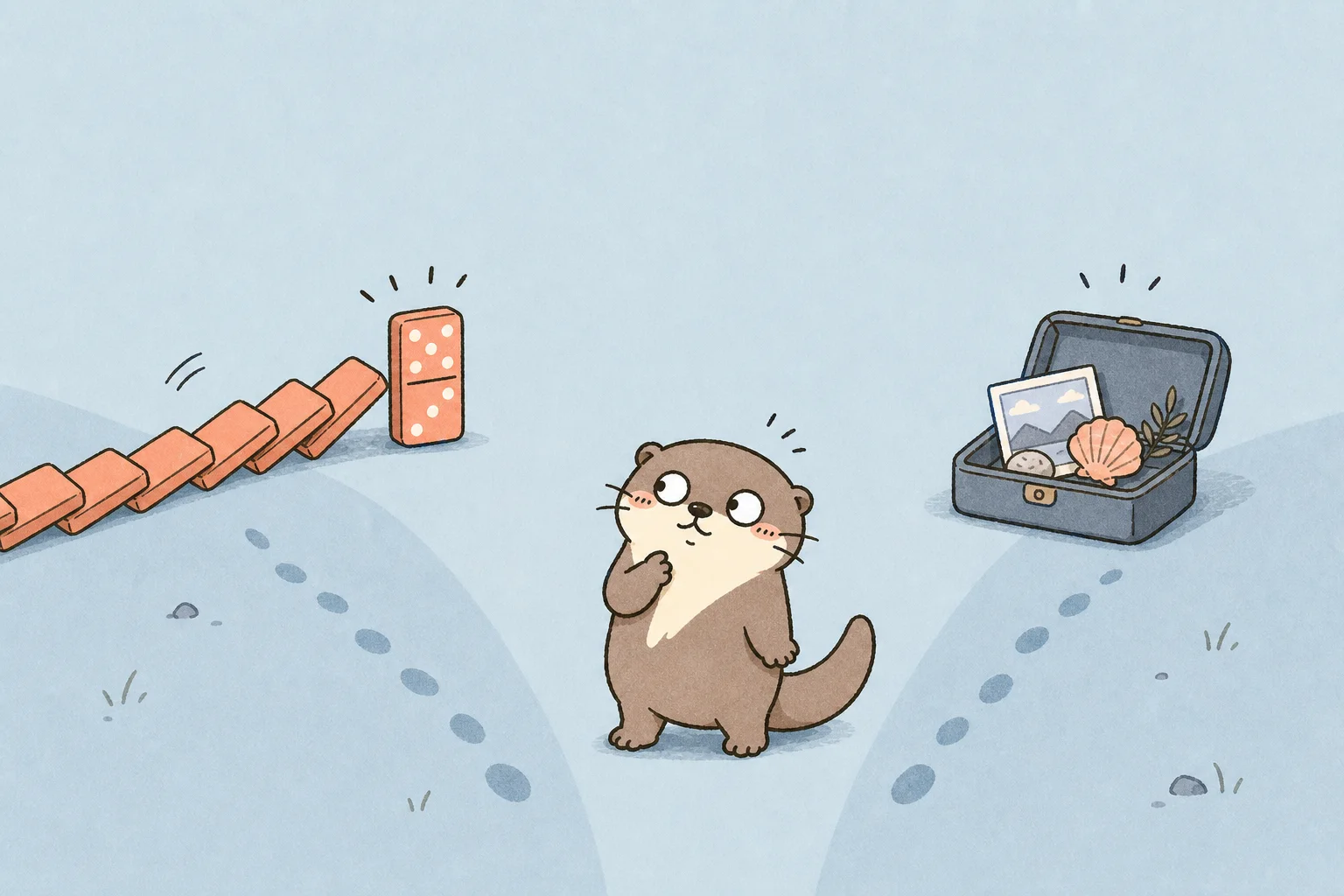
了 (le) presents a particular event as a bounded whole; 过 (guo) says that someone has had an experience at least once before. Compare 我去了北京我去了北京 (Wǒ qù le Běijīng, I went to Beijing) with 我去过北京我去過北京 (Wǒ qù guo Běijīng, I have been to Beijing). The first reports a trip. The second adds “being to Beijing” to the person’s experience.
| What you mean | Marker | Example |
|---|---|---|
| this event occurred as a bounded episode | 了 | 我看了那部电影。我看了那部電影。 — I watched that film. |
| this kind of event has happened before | 过過 | 我看过那部电影。我看過那部電影。 — I have seen that film. |
Both are aspect markers, not past-tense endings. Oxford’s overview of tense and aspect in Mandarin identifies perfective 了 and experiential 过過 among Mandarin’s core aspect markers.
When should you use 了?
Use verb-associated 了 when the speaker views a specific event as one bounded occurrence. A time, quantity, result, or clear context often supplies its boundary.
我昨天买了两本书。我昨天買了兩本書。Wǒ zuótiān mǎi le liǎng běn shū. I bought two books yesterday.
他吃了饭就走了。他吃了飯就走了。Tā chī le fàn jiù zǒu le. He left as soon as he had eaten.
The point is not merely that these events are in the past. The speaker advances a sequence: two books were bought; eating occurred, then leaving occurred. A future event can also take 了 when it is completed before another event:
写了作业再玩。寫了作業再玩。Xiě le zuòyè zài wán. Finish your homework before playing.
Read the full guide to what 了 means in Chinese for sentence-final change-of-state 了 as well as this verb-associated use.
When should you use 过過?
Use 过過 after a verb when the relevant fact is that the subject has experienced that event before an understood reference time.
你吃过臭豆腐吗?你吃過臭豆腐嗎?Nǐ chī guo chòu dòufu ma? Have you ever eaten stinky tofu?
我小时候学过钢琴。我小時候學過鋼琴。Wǒ xiǎoshíhou xué guo gāngqín. I studied piano when I was young.
The second sentence often suggests that piano study is a former experience, not necessarily a present activity. Linguistic work on experiential 过過 analyzes it as asserting that at least one event of that type exists before the reference time, while context creates the common sense that the old situation no longer continues (Linguistics, 2021).
过過 does not always translate as “ever”
“Ever” makes the contrast obvious in questions, but natural English may use a simple past:
我以前在上海住过。我以前在上海住過。Wǒ yǐqián zài Shànghǎi zhù guo. I used to live in Shanghai. / I lived in Shanghai before.
The Chinese still presents living in Shanghai as a previous experience. Translate the whole sentence, not the particle in isolation.
How does the meaning change in the same sentence?
Minimal pairs make the contrast easier to hear.
我看了这部电影我看了這部電影 vs 我看过这部电影我看過這部電影
- 我看了这部电影我看了這部電影 reports a particular viewing, perhaps as part of what happened last night.
- 我看过这部电影我看過這部電影 answers whether the film is already in your viewing experience.
他去了一次他去了一次 vs 他去过一次他去過一次
- 他去了一次他去了一次 (Tā qù le yí cì) counts one visit in a particular narrative.
- 他去过一次他去過一次 (Tā qù guo yí cì) says he has had that experience once before.
The count does not decide the marker by itself. What matters is whether the speaker is narrating the occurrence or establishing prior experience.
How do you negate 了 and 过過?
For an event that did not happen, use 没沒 or 没有沒有 and normally remove perfective 了:
我没看那部电影。我沒看那部電影。Wǒ méi kàn nà bù diànyǐng. I didn’t watch that film.
To deny any previous experience, keep 过過:
我没看过那部电影。我沒看過那部電影。Wǒ méi kàn guo nà bù diànyǐng. I have never seen that film.
This pair is especially useful: 没看沒看 denies the relevant viewing event; 没看过沒看過 denies that any such viewing belongs to your experience.
Can 了 and 过過 appear together?
Yes, because they can contribute different information:
我去过三次了。我去過三次了。Wǒ qù guo sān cì le. I’ve been there three times now.
Here 过過 marks prior experience. The final 了 updates the current count: it has now reached three. This is not the same as mechanically attaching both markers to every past sentence.
You may also encounter 吃过了吃過了 in answers, where final 了 helps present “having eaten” as the newly relevant state. In many neutral contexts, 吃过吃過 or 吃了吃了 is enough; choose according to the contrast the conversation needs.
Which marker belongs in common questions?
Use 了 when asking whether the expected event has occurred in the current situation:
你吃饭了吗?你吃飯了嗎?Nǐ chīfàn le ma? Have you eaten?
Use 过過 when asking about life experience:
你吃过北京烤鸭吗?你吃過北京烤鴨嗎?Nǐ chī guo Běijīng kǎoyā ma? Have you ever eaten Beijing roast duck?
The first question is often practical: should we eat now? The second is biographical: is this food already part of your experience?
How can you choose quickly in real speech?
- Identify the verb and the event.
- If the sentence narrates a particular bounded occurrence, try 了.
- If it establishes “at least once before,” try 过過.
- With 没沒, decide whether you deny this event (没看沒看) or all prior experience (没看过沒看過).
- Notice whether a final 了 updates the situation rather than marking the verb.
Save contrasting complete lines instead of flashcards that say only “了 = completed” and “过 = experienced.” The surrounding object, time phrase, and conversation tell you which perspective the speaker chose.