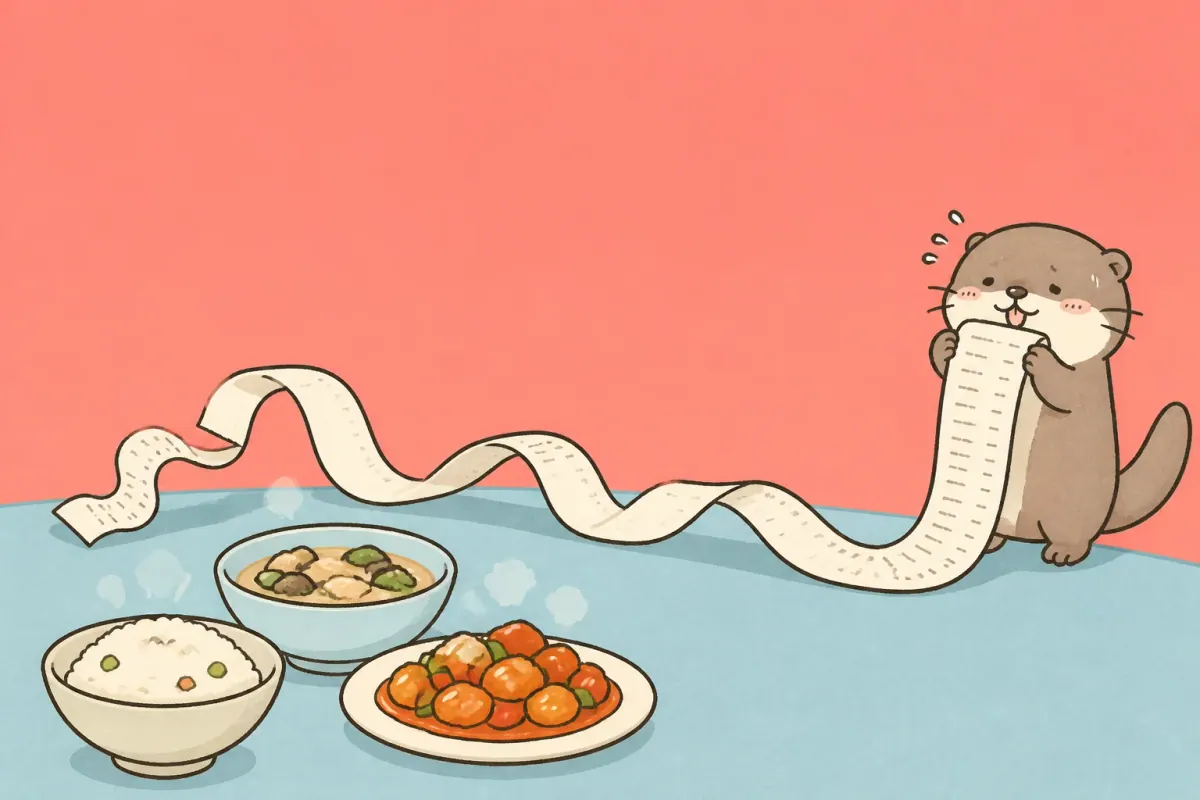
You can handle most restaurant orders with a small set of flexible phrases: ask for the menu, point and say what you want, give the quantity, state important dietary needs clearly, and ask to pay. You do not need a perfect speech.
The safest basic pattern is:
我要这个。
Wǒ yào zhège.
I'd like this one.
Add a number and measure word when needed: 我要两份这个。 (Wǒ yào liǎng fèn zhège.), “I'd like two portions of this.”
How do you ask for a table and the menu?
At the entrance, say how many people are in your group:
三位。 Sān wèi. — Three people.
位 (wèi) is a polite measure word for people. You can ask:
- 有三个人的位子吗? (Yǒu sān ge rén de wèizi ma?) — Do you have a table for three?
- 请给我菜单。 (Qǐng gěi wǒ càidān.) — Please give me a menu.
- 有英文菜单吗? (Yǒu Yīngwén càidān ma?) — Is there an English menu?
In a casual restaurant, simply saying the number of people is often enough.
What is the easiest way to order a dish in Chinese?
Pointing is normal. Use 这个 (zhège, this one) with a clear quantity:
- 我要这个。 — I'd like this.
- 来一份这个。 (Lái yí fèn zhège.) — One order of this, please.
- 我们要一个宫保鸡丁。 (Wǒmen yào yí ge Gōngbǎo jīdīng.) — We'd like one kung pao chicken.
- 再来一碗米饭。 (Zài lái yì wǎn mǐfàn.) — And another bowl of rice.
份 (fèn) works for a portion or order, 碗 (wǎn) for bowls, 杯 (bēi) for cups, and 瓶 (píng) for bottles. 个/個 (ge) is widely understood when you do not know the specific measure word.
How do you ask what the restaurant recommends?
Use one of these:
- 你们有什么推荐的? (Nǐmen yǒu shénme tuījiàn de?) — What do you recommend?
- 这里的招牌菜是什么? (Zhèlǐ de zhāopái cài shì shénme?) — What is the house specialty?
- 这个辣吗? (Zhège là ma?) — Is this spicy?
If the answer becomes too fast, ask 可以说慢一点吗? (Kěyǐ shuō màn yìdiǎn ma?), “Could you speak a little more slowly?”
How do you say you do not eat something?
For a preference, use 我不吃… (Wǒ bù chī…):
- 我不吃猪肉。 — I don't eat pork.
- 不要香菜。 (Bú yào xiāngcài.) — No cilantro.
- 不要太辣。 (Bú yào tài là.) — Not too spicy.
For an allergy, do not rely only on 我不吃. Say 我对花生过敏。 (Wǒ duì huāshēng guòmǐn.), “I am allergic to peanuts,” and confirm whether the dish or sauce contains them. Serious allergies require more than memorized vocabulary: carry a clearly translated allergy card and verify cross-contact directly with the restaurant.
How do you get a server's attention politely?
Use 你好 (nǐ hǎo) or 不好意思 (bù hǎo yìsi) with eye contact and a small hand gesture. 服务员 (fúwùyuán, server) is understood, but calling the person's job title across the room can sound abrupt in some settings.
Avoid snapping your fingers or shouting. Restaurant norms vary, so follow the room: table service, counter ordering, QR-code ordering, and self-service all require different amounts of spoken Chinese.
How do you ask for water, rice, or utensils?
- 请给我一杯水。 (Qǐng gěi wǒ yì bēi shuǐ.) — Please give me a glass of water.
- 我们还要两碗米饭。 (Wǒmen hái yào liǎng wǎn mǐfàn.) — We also need two bowls of rice.
- 请给我一双筷子。 (Qǐng gěi wǒ yì shuāng kuàizi.) — Please give me a pair of chopsticks.
- 有勺子吗? (Yǒu sháozi ma?) — Do you have a spoon?
Hot water or tea may be more readily offered than cold tap water. Ask specifically for 冰水 (bīngshuǐ) if cold water matters, and expect local practice to differ.
How do you ask for the bill in Chinese?
Say 买单,谢谢。 (Mǎidān, xièxie.), “The bill, please,” or 结账,谢谢。 (Jiézhàng, xièxie.), “I'd like to pay.” In Taiwan, 买单 and 结账 are both understood; local preferences and payment routines vary.
Useful follow-ups include:
- 可以刷卡吗? (Kěyǐ shuākǎ ma?) — Can I pay by card?
- 可以分开付吗? (Kěyǐ fēnkāi fù ma?) — Can we pay separately?
- 可以打包吗? (Kěyǐ dǎbāo ma?) — Can I take this to go?
Payment systems change by restaurant and region. Look for the accepted methods at the counter rather than assuming cash, foreign cards, or a particular mobile wallet will work.
What short restaurant dialogue should you practice?
Server: 几位? (Jǐ wèi?) — How many people?
You: 两位。我们要这个和这个,再来两碗米饭。
Liǎng wèi. Wǒmen yào zhège hé zhège, zài lái liǎng wǎn mǐfàn.
Two. We'd like this and this, plus two bowls of rice.
Server: 要辣吗? (Yào là ma?) — Do you want it spicy?
You: 微辣就好,谢谢。 (Wēilà jiù hǎo, xièxie.) — Mild is fine, thank you.
Practice the exchange with dishes you would genuinely order. Replacing only the food, quantity, and dietary line gives you a reusable script without sounding rehearsed.