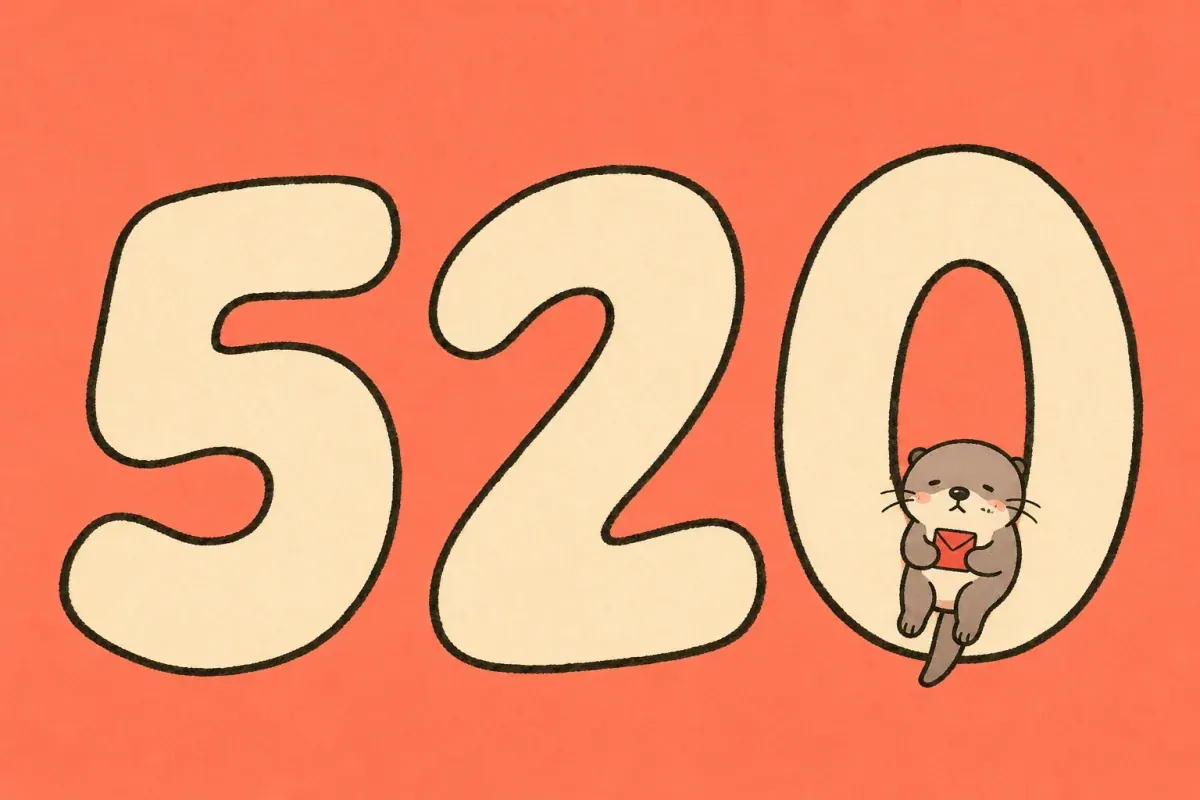
In Chinese internet slang, 520 means “I love you.” The number is read digit by digit as wǔ èr líng, which is treated as a playful approximation of 我爱你 (wǒ ài nǐ).
You will see 520 in messages, social captions, gifts, and posts around May 20. It is usually romantic, although friends, fans, and brands sometimes use it more loosely to express affection.
May 20 is separate from the traditional Qixi Festival and its lunar-calendar story, even though both occasions are associated with romance.
Why does 520 mean “I love you”?
The connection comes from sound:
| Number or phrase | Chinese | Pinyin | Meaning |
|---|---|---|---|
| 520 | 五二零 | wǔ èr líng | five-two-zero |
| I love you | 我爱你 | wǒ ài nǐ | I love you |
These do not sound identical in standard Mandarin. The match is intentionally loose: wǔ resembles wǒ, while èr líng is bent toward ài nǐ. Once the association became familiar online, the shared meaning mattered more than a perfect phonetic match.
This kind of number wordplay is called a numeronym. Chinese internet users often treat each digit as a stand-in for a syllable or word with a similar sound. A University College London study of Chinese social-media language describes 520 as a phonetic numeral expression replacing 我爱你 and notes that the similarity can draw on dialect pronunciation as well as standard Mandarin (Chen, 2023).
How people use 520
In a message or caption
The simplest use is just the number:
520 ❤️
I love you.
Someone might also add it to a goodnight message, an anniversary post, or a photo with their partner. Written this way, 520 can feel cuter and more playful than typing 我爱你 directly.
It is casual internet language, not a phrase for a formal letter or an ordinary face-to-face introduction. People can say 五二零 aloud and be understood, but the number belongs most naturally in messages, captions, comments, gift amounts, and references to the date.
On May 20
Because dates in China are normally written with the month first, May 20 becomes 5/20: 520. The date is widely treated as an unofficial day for confessions, flowers, gifts, dates, proposals, and marriage registrations.
This is more than an obscure online pun. In 2026, the Chinese Embassy in Japan opened a dedicated May 20 marriage-registration session for 30 couples (Chinese Embassy in Japan, 2026), while Guangzhou’s Nansha marriage registry reported serving 181 couples that day after adding staff and service windows (Nansha District Civil Affairs Bureau, 2026).
You may see greetings such as:
520快乐!
Wǔ èr líng kuài lè!
Happy 520!
Calling it “Chinese Valentine’s Day” is convenient, but “Internet Valentine’s Day” is more precise. It is a modern informal observance, separate from the Qixi Festival and February 14.
In gifts and money
The number can also shape a romantic gift amount. A transfer, red envelope, bouquet count, price, or discount may use 5.20, 52.0, 520, or another visible variation. Context tells you whether 520 is simply a number or an affectionate message.
Do not assume every appearance is romantic. Room 520, bus 520, and a total of ¥520 can still be ordinary numbers unless the surrounding situation invites the pun.
Is 520 as serious as saying 我爱你?
Not necessarily. The literal message is the same, but the tone can differ.
- 我爱你 is direct and unmistakable.
- 520 is coded, playful, and strongly associated with texting and online culture.
- 520! between close friends or fans can be exaggerated affection rather than a romantic confession.
- A 520 promotion from a shop is seasonal marketing, not a declaration of love from the cashier.
Relationship and context do the real work. If someone you are dating sends only “520,” the romantic meaning is obvious. If a creator posts “520” to thousands of followers, it is more likely a warm “love you all.” The University of Pennsylvania’s Chinese translation guidelines even use a social-media example where 520 extends affection to family, friends, and followers, showing that the code is not limited to couples (Linguistic Data Consortium, 2024).
What do 521 and 5201314 mean?
You will often meet nearby number codes, but they are not all equally fixed.
521
521 can also be used as a version of “I love you,” and some online explanations assign it meanings such as “I’m willing” or treat it as a reply to 520. Those extra rules are inconsistent. It is safer to read 521 as another romantic number pun and use the surrounding message to decide what the sender intended.
5201314
5201314 expands the message:
520 + 1314
我爱你 + 一生一世
wǒ ài nǐ + yī shēng yī shì
I love you for a lifetime.
Here, 1314 is associated with 一生一世, literally “one life, one lifetime.” The full string is deliberately dramatic and is most at home in romantic posts, fandom messages, usernames, gift notes, and playful declarations.
A quick way to remember 520
Remember the meaning first, not a forced sound-by-sound equation:
520 → a numeric way to write “I love you” online
Then keep the real pronunciations separate:
- 五二零 — wǔ èr líng
- 我爱你 — wǒ ài nǐ
When 520 appears beside hearts, couples, gifts, May 20, or an affectionate caption, you can confidently read the intended message. When it appears on a ticket, address, or receipt, check the context before turning it into a love confession.