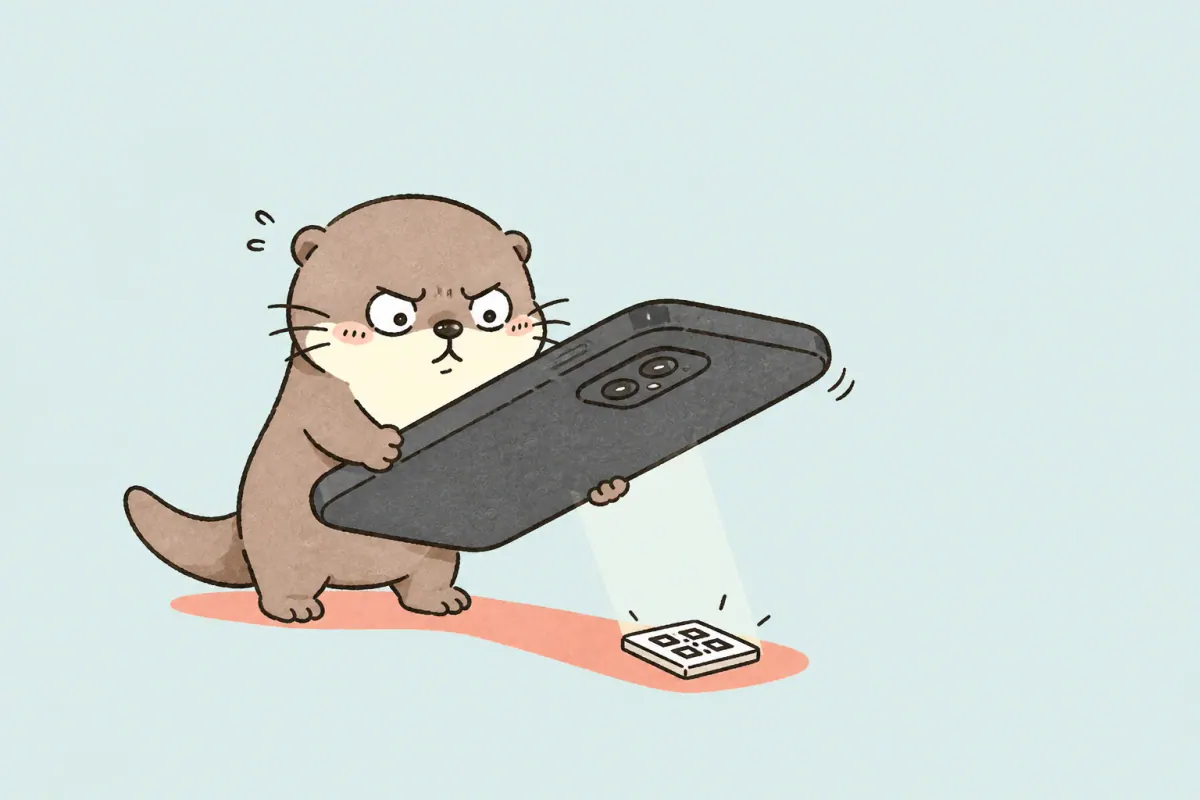
扫码 (sǎo mǎ) means “scan a code.” In everyday Chinese, the code is usually a QR code, and the phrase appears anywhere a phone connects a physical place to a digital action: paying, ordering food, opening a menu, adding a contact, logging in, or unlocking a shared bicycle.
The two characters are quite literal: 扫 (sǎo) means “to sweep” and, in modern technology, “to scan”; 码 (mǎ) means “code.” The full word for QR code is 二维码 (èr wéi mǎ), but when the context is obvious, people simply say 码.
What exactly does 扫码 mean?
It describes the action of using a phone or scanner to read a barcode or QR code. It does not automatically mean “pay.” The result depends on the code: one code opens a menu, another starts a payment, and another adds an account.
Common forms include:
- 扫码 (sǎo mǎ) — scan a code
- 扫一扫 (sǎo yì sǎo) — give it a scan; also a common label for a scanning function
- 扫描二维码 (sǎomiáo èr wéi mǎ) — scan the QR code; more explicit and slightly more formal
- 扫码进入 (sǎo mǎ jìnrù) — scan to enter
- 扫码点单 (sǎo mǎ diǎndān) — scan to order
- 扫码支付 (sǎo mǎ zhīfù) — scan to pay
On a sign, 请扫码 (qǐng sǎo mǎ) usually means “Please scan the code.” A person may say the shorter 扫一下 (sǎo yíxià), “Scan it for a moment.”
Are you scanning the merchant's code or showing your own?
QR payment can work in two opposite directions. Sometimes you scan the merchant's code; sometimes the merchant scans the payment code on your phone. This is the distinction that matters most at a checkout.
| What happens | Code you see | Useful Chinese |
|---|---|---|
| You scan the merchant's code and enter or confirm the amount | 收款码 (shōukuǎn mǎ), collection code | 我扫这个吗? (Wǒ sǎo zhège ma?) — Do I scan this one? |
| You open a code on your phone and the cashier scans it | 付款码 (fùkuǎn mǎ), payment code | 请出示付款码。 (Qǐng chūshì fùkuǎn mǎ.) — Please show your payment code. |
China's official payment terminology calls these 付款扫码—the payer scans the recipient's code—and 收款扫码—the recipient scans the payer's code. The People's Bank of China barcode-payment rules define both flows, while the current payment guide for visitors to China explains them as scanning a merchant code or presenting your own.
The formal labels are useful when reading instructions, but ordinary conversation is simpler:
我扫你还是你扫我?
Wǒ sǎo nǐ háishi nǐ sǎo wǒ?
Do I scan yours, or do you scan mine?
Here, “you” and “me” stand for the codes on each person's side of the transaction.
Which payment words appear around 扫码?
Several nearby words tell you what the code is for and what happens next.
| Chinese | Pinyin | Meaning |
|---|---|---|
| 支付 | zhīfù | to pay; payment |
| 付款 | fùkuǎn | to make a payment |
| 收款 | shōukuǎn | to receive payment |
| 金额 | jīn'é | amount of money |
| 确认 | quèrèn | confirm |
| 支付成功 | zhīfù chénggōng | payment successful |
| 支付失败 | zhīfù shībài | payment failed |
| 重新扫码 | chóngxīn sǎo mǎ | scan again |
If a cashier says 扫这边 (sǎo zhèbiān), they are directing you to the code on their side. If they say 付款码打开一下 (fùkuǎn mǎ dǎkāi yíxià), open your payment code for them to scan.
For the restaurant step immediately before payment, see how 扫码结账 fits into asking for the bill in Chinese.
What can you say when the code will not scan?
Say what is failing, then ask which code or method to use. These short lines cover most awkward moments:
- 扫不出来。 (Sǎo bu chūlái.) — It won't scan.
- 扫不了。 (Sǎo bu liǎo.) — I can't scan it.
- 我应该扫哪个码? (Wǒ yīnggāi sǎo nǎge mǎ?) — Which code should I scan?
- 是这个码吗? (Shì zhège mǎ ma?) — Is it this code?
- 可以再试一次吗? (Kěyǐ zài shì yícì ma?) — Can we try again?
- 可以用别的方式支付吗? (Kěyǐ yòng bié de fāngshì zhīfù ma?) — Can I pay another way?
The result complement in 扫出来 means that scanning successfully produces a result. Adding 不 gives the very natural 扫不出来: the camera sees the code, but nothing useful appears.
Is 扫码 only used for payments?
No. Payment is only one common use. The phrase stays the same while the surrounding verb tells you the purpose.
- 扫码点餐 (sǎo mǎ diǎncān) — scan to order food
- 扫码登录 (sǎo mǎ dēnglù) — scan to log in
- 扫码加好友 (sǎo mǎ jiā hǎoyǒu) — scan to add a contact
- 扫码开锁 (sǎo mǎ kāisuǒ) — scan to unlock
- 扫码取件 (sǎo mǎ qǔjiàn) — scan to collect a parcel
- 扫码关注 (sǎo mǎ guānzhù) — scan to follow an account
That makes 扫码 a compact modern verb rather than one fixed instruction. When you hear it, look for the code first and the purpose second.