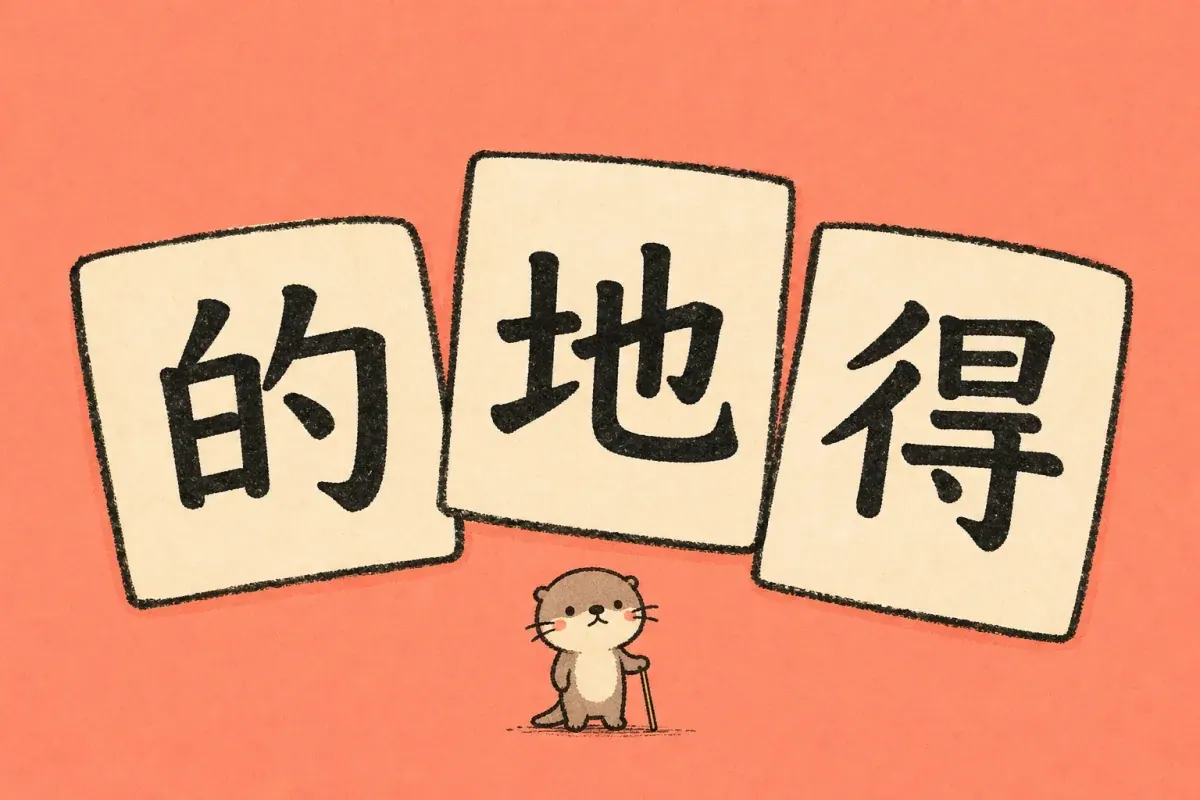
的, 地, and 得 are all pronounced de in their common grammatical uses, but they sit in different places in a sentence. The quickest way to choose is to look at what comes immediately after de:
| What comes after de? | Use | Pattern | Example |
|---|---|---|---|
| A noun | 的 | description + 的 + noun | 好看的电影 — a good-looking film |
| An action | 地 | manner + 地 + verb | 认真地听 — listen carefully |
| A comment about the action | 得 | verb + 得 + complement | 说得很清楚 — speak very clearly |
That test handles most everyday cases. If the word after de is a thing, person, or idea, start with 的. If it is an action, start with 地. If de comes after the action and introduces how well, how much, or with what result it happened, use 得.
These three written particles are different from the particles that shape a speaker’s tone at the end of a sentence; see the guide to Chinese sentence-final particles for that separate system.
Why do the three de particles sound the same?
In these patterns, all three characters are normally read with a light, neutral tone: de. That is why the difference is mostly invisible in conversation. You hear the grammar of the whole phrase, not three clearly different syllables.
The same characters can have other pronunciations when they do other jobs. 得 can be dé in 得到 (“obtain”) or děi when it means “must.” 地 is dì in 地图 (“map”) and 地方 (“place”). Those are separate words, not the structural particles discussed here.
Use 的 before a noun
的 connects a description, owner, or other modifier to a noun:
我的书
wǒ de shū
my book
很有意思的节目
hěn yǒu yìsi de jiémù
a very interesting show
我昨天买的衣服
wǒ zuótiān mǎi de yīfu
the clothes I bought yesterday
The part before 的 can be a pronoun, an adjective, or an entire clause. The part after it is the noun being identified or described.
的 can stand in for the noun
When everyone already knows what noun you mean, it can disappear while 的 remains:
你喜欢哪个?红色的。
Nǐ xǐhuan nǎge? Hóngsè de.
Which one do you like? The red one.
这是我做的。
Zhè shì wǒ zuò de.
This is the one I made.
This is still the same basic job: 的 marks the description of an understood noun.
Sometimes 的 is naturally omitted
Not every modifier needs an audible 的. Closely bonded expressions often leave it out:
- 我妈 rather than 我的妈妈 in ordinary conversation;
- 中国菜, not 中国的菜, when you mean Chinese cuisine;
- 新同学 and 好朋友 as familiar adjective–noun combinations.
Longer or more specific descriptions usually keep it: 我在北京认识的朋友 (“the friend I met in Beijing”). Adding or removing 的 can also change the rhythm or emphasis, so omission is not a rule you need to force into every short phrase.
Use 地 before an action
地 turns a description into the manner in which an action is performed. It comes before the verb:
她认真地听。
Tā rènzhēn de tīng.
She listens attentively.
请慢慢地说。
Qǐng mànmàn de shuō.
Please speak slowly.
孩子们高兴地跑了进来。
Háizimen gāoxìng de pǎo le jìnlái.
The children ran in happily.
If English would use an adverb such as “carefully,” “quietly,” or “happily,” 地 is often the Chinese link between that manner and the action.
Why you often do not see 地 in casual Chinese
Short, familiar adverbial expressions commonly drop 地, especially in speech:
- 慢慢说 — speak slowly
- 好好休息 — have a good rest
- 努力学习 — study hard
- 早点睡 — go to bed earlier
The version with 地 is not automatically wrong. 慢慢地说 may feel more deliberate or put more focus on the manner. Longer descriptions are also more likely to need the particle: 他一字一句地解释 (“he explains it word by word”).
For an exam or edited text, learn the standard pattern first. When listening, expect native speakers to omit 地 where the relationship is already obvious.
Use 得 after an action
得 comes after a verb or adjective and introduces a complement: information about degree, manner, result, or possibility.
她跑得很快。
Tā pǎo de hěn kuài.
She runs very fast.
你说得很清楚。
Nǐ shuō de hěn qīngchu.
You explained it very clearly.
我们吃得很饱。
Wǒmen chī de hěn bǎo.
We ate until we were full.
他累得不想动。
Tā lèi de bù xiǎng dòng.
He is so tired that he does not want to move.
Notice the direction of the sentence. 地 sets up the manner before the action; 得 comments on the action after it.
What happens when the verb has an object?
The 得 complement needs to stay close to the verb. With a verb–object phrase, Chinese often moves the object forward or repeats the verb:
他中文说得很好。
Tā Zhōngwén shuō de hěn hǎo.
He speaks Chinese very well.
她唱歌唱得很好听。
Tā chànggē chàng de hěn hǎotīng.
She sings beautifully.
Do not put a long object between the verb and 得 and expect the complement to attach cleanly. Keep the pattern visible: verb + 得 + comment.
See all three with the same idea
These sentences use the same vocabulary but change the grammar:
| Sentence | What it describes |
|---|---|
| 清楚的解释 | a clear explanation — 的 points forward to a noun |
| 清楚地解释 | explain clearly — 地 points forward to an action |
| 解释得很清楚 | explain it very clearly — 得 looks back at the action |
This contrast is more useful than memorizing three English labels. Ask what the phrase is building: a noun phrase, a way of doing something, or a comment on what was done.
Common mistakes and how to fix them
1. Using 的 after the verb
我说的很快。 ❌
我说得很快。 ✅
“Very fast” comments on how I speak, so the particle comes after the verb and is written 得.
2. Using 的 before an action
他安静的坐着。 ❌ in standard edited writing
他安静地坐着。 ✅
“Quietly” describes the action of sitting, so use 地.
3. Using 地 before a noun
我喜欢地电影 ❌
我喜欢的电影 ✅
The clause “I like” identifies a film, so it connects to the noun with 的.
4. Correcting speech as if it were spelling
When someone says de, you cannot hear which character they “used.” The distinction appears when the sentence is written. In informal messages, people sometimes type 的 where standard writing calls for 地, partly because the sound is identical and the meaning remains clear. Learn to recognize that habit, but use the standard forms in careful writing.
How can you choose the right de in ten seconds?
- Find the word immediately after de.
- If it is a noun, choose 的.
- If it is a verb or action, choose 地.
- If de follows the verb and introduces a degree, result, or description, choose 得.
- Read the phrase once without the particle. If it is a short fixed expression such as 好好休息 or 我妈, omission may be more natural.
The compact memory aid is: 的 before things, 地 before actions, 得 after actions. It is not the whole grammar, but it gets you to the right answer remarkably often.
The analysis here follows the standard modifier, adverbial, and complement patterns described in a 2023 linguistic review of 的、地、得, with learner examples cross-checked against Omeida Chinese Academy’s usage guide.