Chinese characters are written units that usually represent a spoken syllable and a morpheme, the smallest meaningful part of a word. They are not an alphabet, and most are not little pictures. Their shapes are built from strokes and recurring components; many combine a broad meaning clue with a pronunciation clue.
That description explains more than either popular extreme: “each symbol is a picture” is too simple, while “characters give no sound information” ignores the phonetic structure inside a large part of the writing system.
Does one Chinese character equal one word?
Sometimes, but not usually as a universal rule. A character often represents one morpheme, and modern Chinese words may contain one, two, or more morphemes.
- 人 (rén, person) can be a word by itself.
- 手机 (shǒujī, mobile phone) contains 手 “hand” and 机/機 “machine.”
- 图书馆 (túshūguǎn, library) contains three written syllables and several meaningful parts.
There are also multi-character words whose pieces are not useful literal translations in current usage. Read words first, then use character structure to deepen them.
Are Chinese characters pictures?
A small group began as stylized representations, and their history can still help: 日 “sun,” 月 “moon,” and 木 “tree.” But modern printed forms are conventional symbols, not drawings, and most characters are better understood through components and historical sound-meaning construction.
Calling the whole system pictographic creates bad study habits. Learners may invent a visual story for every shape while ignoring pronunciation, word formation, and recurring components.
How are characters built?
Characters use a limited inventory of strokes arranged into components, and components occupy positions such as left, right, top, bottom, inside, or outside.
For example:
- 好 combines 女 and 子;
- 明 combines 日 and 月;
- 问 places 口 inside 门;
- 想 places 心 below 相.
Structure matters because the same strokes in a different arrangement may form another character or no valid character at all. Unicode describes Han ideographs with a component-tree model when discussing their abstract structure (Unicode Standard, Chapter 18).
How do characters show meaning and sound?
Many characters are semantic-phonetic compounds. One component points loosely toward meaning; another reflects a historical pronunciation.
Consider the 青 (qīng) family:
| Character | Meaning clue | Sound clue | Modern reading |
|---|---|---|---|
| 清 “clear” | 氵 water | 青 | qīng |
| 情 “feeling” | 忄 heart | 青 | qíng |
| 请 “please; request” | 讠 speech | 青 | qǐng |
| 晴 “clear weather” | 日 sun | 青 | qíng |
The family helps with both meaning and pronunciation, but tones differ. Centuries of sound change and script change prevent perfect prediction.
Why can one character have several pronunciations?
Characters can participate in different words, preserve readings from different histories, or change pronunciation by grammatical use.
行 is read xíng in 不行 (bù xíng, not okay) but háng in 银行 (yínháng, bank). 得 can be dé, děi, or the neutral-tone complement marker de.
This is another reason to learn characters in words. “行 = xíng” is only a partial entry.
How do simplified and traditional characters relate?
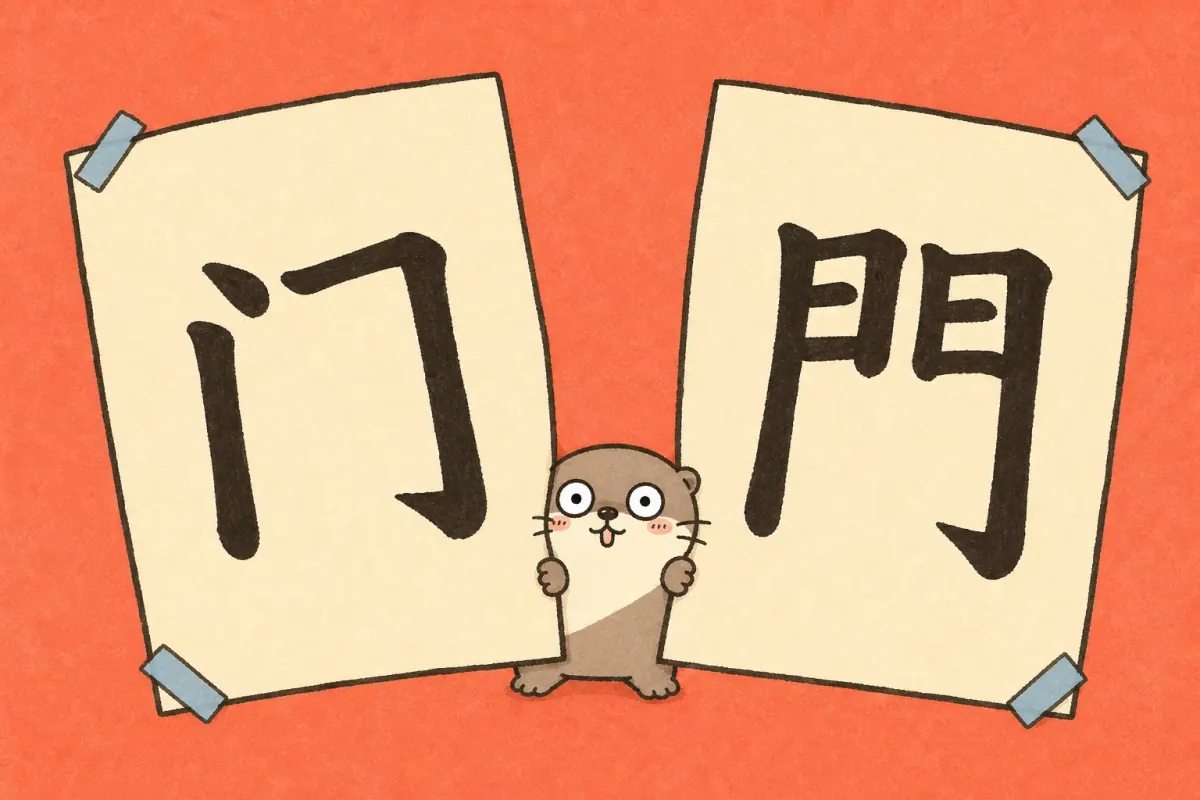
Simplified and traditional Chinese are two character-form systems, not two separate spoken languages. Some characters are shared, some have systematic component substitutions, and some mappings are many-to-one.
Examples include:
- 门 (mén, door);
- 说 (shuō, speak);
- 学习 (xuéxí, study).
A simplified form cannot always be converted character by character without word context. The simplified 后 corresponds to traditional 後 in “after,” but traditional 后 remains 后 in the title for an empress.
How does Chinese text show word boundaries?
Normal Chinese writing does not put spaces between every word. Readers segment a character string by vocabulary, grammar, and context.
我想学中文 can be understood as:
我 | 想 | 学 | 中文
I | want | to learn | Chinese
But the written line normally appears without those separators. Fluent reading therefore depends on recognizing multi-character words quickly, not merely naming individual characters.
What should beginners learn for each character?
Use a compact record:
- the character and, when relevant, its other script form;
- one common pronunciation in a real word;
- one central meaning;
- one useful component clue;
- one contrasting word or lookalike.
For 情, that might be 感情 (gǎnqíng, feelings/affection), the 心 meaning component, the 青 sound family, and a comparison with 请 (qǐng, please/request).
Do you need to memorize character origins?
No. Reliable history can clarify a confusing form, but modern reading does not require an etymology for every character. Prioritize current structure, pronunciation, and words. Use historical explanations only from trustworthy references, and label personal visual stories as mnemonics rather than facts.