For most learners, the choice between simplified and traditional Chinese comes down to one practical question: where—and with whom—do you want to use Chinese? Learn simplified if mainland China or Singapore is your main focus. Learn traditional if you are most interested in Taiwan, Hong Kong, or Macau. If your plans are still open, simplified is usually the easier default simply because beginner courses, apps, and online material are easier to find in it.
That choice is not permanent. The two systems share most of their characters, and reading one gives you a strong base for recognizing the other later. You do not need to study both equally from day one.
If Taiwan is your focus, keep script separate from regional speech: the Taiwan versus mainland Mandarin guide covers vocabulary, pronunciation, and usage beyond character shape.
Simplified and traditional are writing systems, not different spoken languages
简体字 (jiǎntǐzì) and 繁体字 (fántǐzì) are two sets of written character forms. They do not tell you by themselves whether somebody is speaking Mandarin, Cantonese, Hokkien, or another Chinese language.
The same Mandarin sentence can be written either way:
我想学中文。
Wǒ xiǎng xué Zhōngwén.
I want to learn Chinese.
The pronunciation and basic meaning are the same. Only one character changes form in this sentence: 学. 中 and the other characters are identical in both systems.
This distinction matters because “traditional Chinese” is sometimes treated as if it meant Taiwanese Mandarin, while “simplified Chinese” is treated as mainland Mandarin. Script and regional language variety often travel together, but they are not the same choice. Taiwan and mainland China also differ in some vocabulary and pronunciation; changing the character shapes alone does not rewrite a text for another region.
What actually changed during simplification?
Many characters are identical in both systems. Unicode’s current description of Chinese writing notes that the vast majority remain the same. Where forms do differ, simplification followed several patterns rather than one rule applied to everything (Unicode Standard, Chapter 18).
Some common components were given shorter forms:
| Component or character | Simplified | Traditional | Example |
|---|---|---|---|
| speech component | 讠 | 言 | 说 shuō, speak |
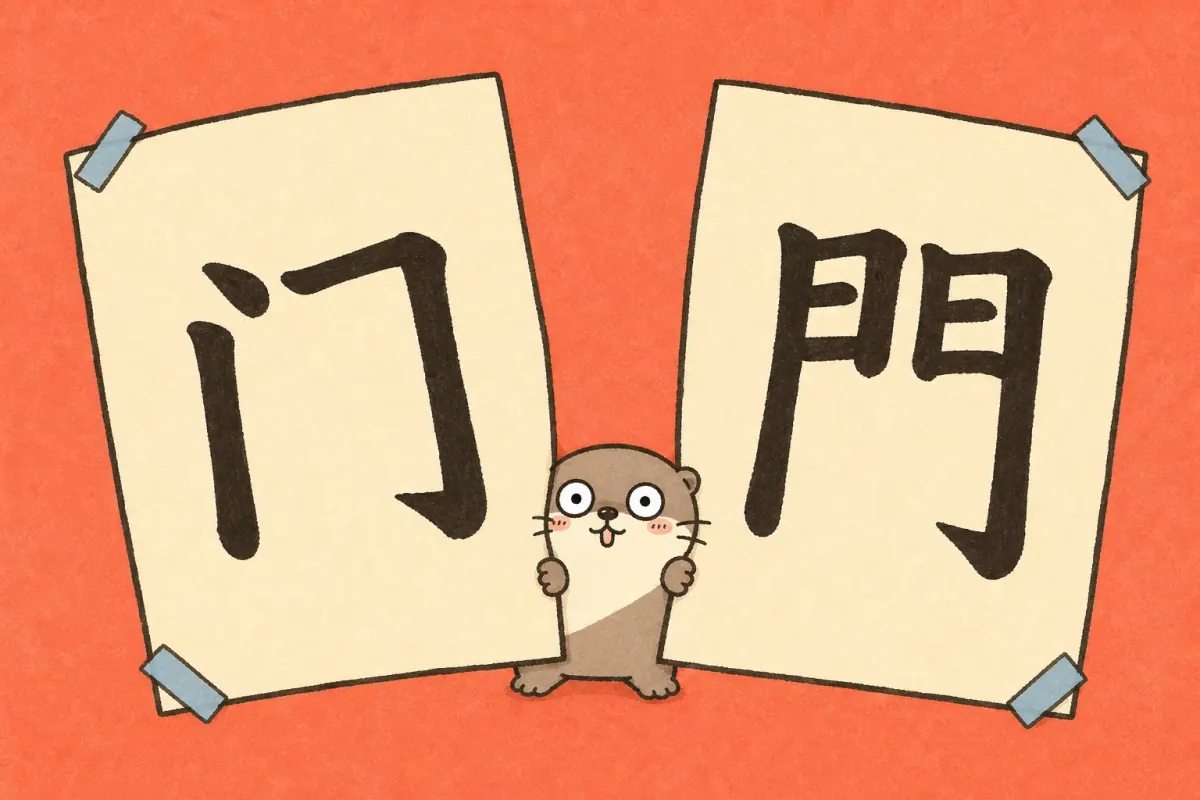
| gate component | 门 | 門 | 问题 wèntí, question |
| horse component | 马 | 馬 | 妈妈 māma, mother |
| book | 书 | 書 | 看书 kàn shū, read |
Other simplified forms came from long-established handwritten or variant forms. Some were replaced by a simpler character with the same pronunciation. The result is a standardized system, but not a code in which you can always add or remove a predictable number of strokes.
Compare a short group:
- unchanged: 人、山、在、好
- visibly related: 语、门、见、车
- less obvious at first glance: 书、买、听、乐
The related forms become much easier once you recognize recurring components. You are not memorizing every pair as an unrelated picture.
Conversion is not always one character in, one character out
An important complication is that several traditional characters can share one simplified form. For example:
- 头发 (tóufa, hair) uses traditional 发.
- 发展 (fāzhǎn, develop) uses traditional 发.
In simplified Chinese, both 髮 and 發 become 发. A conversion tool therefore has to understand the word, not merely replace each character from a lookup table.
The same problem appears with 干 and 后. Unicode’s Unihan documentation warns that conversion can be one-to-many and may require context; it also notes that regional vocabulary has to be handled word by word, not just character by character (Unicode Standard Annex #38).
For learners, the lesson is simple: automatic conversion is useful for getting the gist, but do not assume every converted sentence is polished local writing.
Where each script is used
The broad regional pattern is:
| Place | Script you will usually encounter |
|---|---|
| Mainland China | Simplified |
| Singapore | Simplified |
| Taiwan | Traditional |
| Hong Kong | Traditional |
| Macau | Traditional |
| Malaysia and overseas communities | Mixed; it depends on school, publication, family, and community |
Mainland China’s language law establishes standardized Chinese characters for government, education, publishing, public services, and other public uses (PRC Ministry of Education). Singapore’s current primary Chinese syllabus and teaching materials use simplified forms (Singapore Ministry of Education).
Taiwan’s Ministry of Education publishes traditional-character dictionaries and standard stroke-order resources (Taiwan Ministry of Education). Hong Kong’s Education Bureau describes traditional characters as the form used by most residents and media in Hong Kong, as well as in Macau and Taiwan (Hong Kong Education Bureau).
These are useful defaults, not walls. You will see traditional characters on old buildings and in calligraphy in mainland China. You will see simplified posts, products, and visitors in traditional-character regions. Many people can read both to some degree.
Is simplified Chinese easier?
It is easier in one narrow sense: characters that were simplified generally take fewer strokes to write. Compare 边, 体, and 网. If handwriting speed is the only measure, the simplified forms win.
Reading is less clear-cut. Traditional characters sometimes preserve components that make character families or older forms easier to see. Simplified Chinese sometimes reduces visual complexity and makes dense beginner text feel less intimidating. Neither advantage removes the real work of learning vocabulary, pronunciation, grammar, and thousands of character-word connections.
Claims that one system is inherently logical and the other is hopelessly arbitrary are not very useful to a learner. Both contain helpful patterns, historical leftovers, sound components that no longer match perfectly, and characters you will simply have to meet repeatedly.
Your environment usually matters more than the stroke-count argument. A supposedly “easier” script becomes inconvenient if none of your teachers, friends, books, or favorite shows use it.
Is traditional Chinese better for understanding character origins?
Traditional forms can preserve distinctions and components that disappeared during simplification. 亲 retains 見, and 爱 retains 心 in the traditional forms 親 and 愛. These visible pieces can be memorable.
But character history is more complicated than a popular graphic that splits a modern character into a charming story. Components can represent sound, meaning, historical borrowing, or shapes that changed across centuries. Traditional does not automatically reveal a character’s true etymology, and simplified does not make etymology impossible to study.
If history and calligraphy are major interests, traditional characters give you more direct access to many older forms and publications. That is a good reason to choose them—not proof that every beginner needs to begin there.
Which script should you learn?
Choose simplified Chinese if…
- you expect to live, study, work, or travel mainly in mainland China or Singapore;
- most of your friends, teachers, or family contacts use simplified characters;
- your favorite online videos, novels, games, or social platforms are mainly from mainland China;
- you have no strong regional goal and want the largest pool of beginner resources.
Choose traditional Chinese if…
- Taiwan, Hong Kong, or Macau is your main destination or cultural focus;
- the people you most want to message use traditional characters;
- you plan to study in Taiwan or use Taiwan-produced textbooks and dictionaries;
- older literature, character forms, or calligraphy are central interests.
For Hong Kong, remember that the script choice and spoken-language choice are separate. Traditional characters are standard, but Cantonese is central to everyday life. Learning traditional Mandarin alone does not turn Mandarin into Cantonese.
If you still cannot decide
Look at your next six months, not your imagined lifetime. Which course will you actually take? Which videos will you watch? Which person will you message? Choose the script that removes friction from those real activities.
If the answer is genuinely “either,” start with simplified. This is a practical default, not a verdict that simplified is superior.
Should you learn both at the same time?
Beginners often try to be thorough and create two flashcards for every word. That doubles the visible forms before the underlying word is stable. A better sequence is:
- Learn to read common words comfortably in your main script.
- Notice recurring conversions such as 门/們/马 and 语/说.
- Practise recognizing the other script in short, familiar texts.
- Add regional vocabulary as vocabulary—not as a character-conversion problem.
- Learn to handwrite the second system only if you have a real use for it.
Recognition grows surprisingly quickly because so much is shared and because context carries you through unfamiliar forms. You may not be able to write 聽 from memory after learning 听, but you can learn to recognize it inside 聽懂 long before that.
The best choice is the one attached to real Chinese
Script debates can become emotional because writing carries history, identity, education, and place. A learner does not need to settle that debate before reading a menu.
Choose one system, use it with real people and media, and let the other become familiar gradually. Comfortable reading in one script plus flexible recognition of the other is more valuable than hesitant handwriting in both.