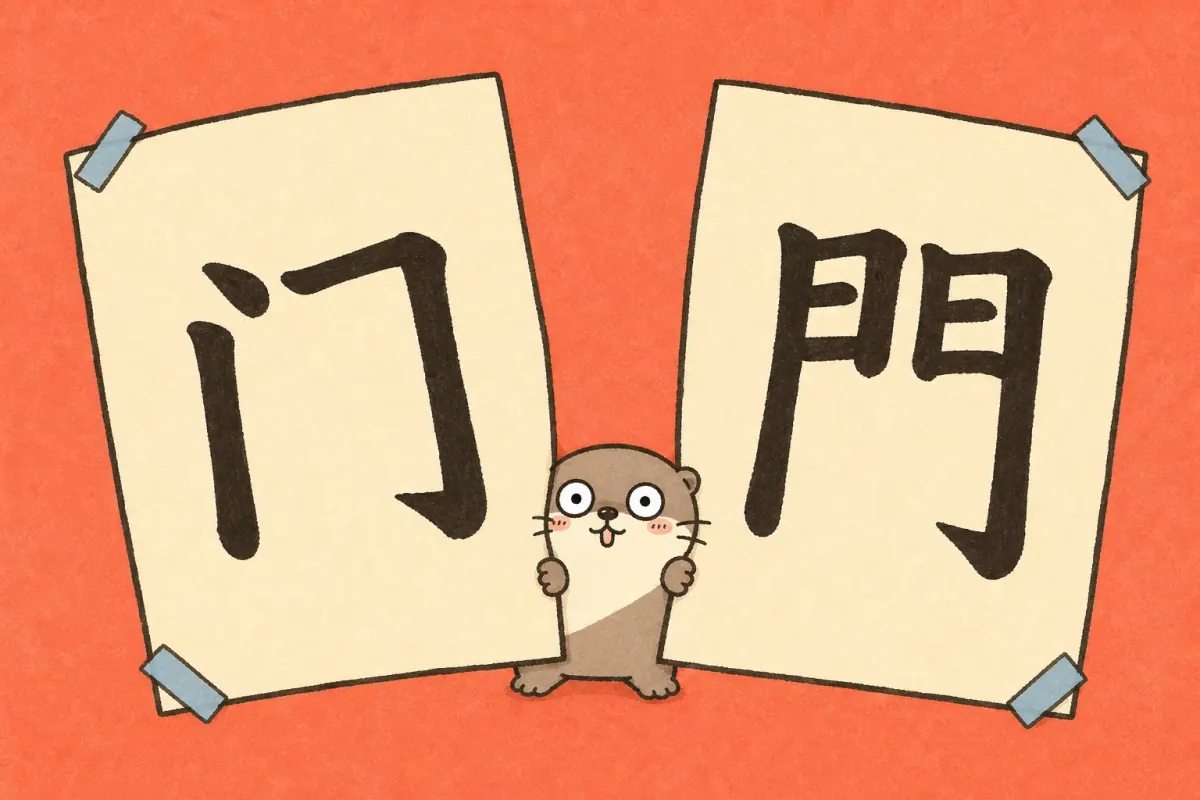
For most people learning Mandarin, pinyin is the best first system. It is used by the largest range of courses, dictionaries, apps, keyboards, and international references. Learn Zhuyin instead—or add it early—if Taiwan is your main focus, you want to use Taiwan’s children’s books and dictionaries, or pinyin’s familiar Latin letters keep pulling you toward English pronunciation.
Both systems represent Mandarin sounds. Neither one is a dialect, accent, or replacement for Chinese characters. Once you understand one system properly, learning to read the other is a small project rather than a second language.
What are pinyin and Zhuyin?
汉语拼音 (Hànyǔ Pīnyīn) writes Standard Mandarin pronunciation with the Latin alphabet:
中文 — Zhōngwén
注音符号 (Zhùyīn Fúhào), usually shortened to Zhuyin and nicknamed Bopomofo after its first four symbols, uses a dedicated set of signs:
中文 — ㄓㄨㄥ ㄨㄣˊ
They encode the same two Mandarin syllables. Pinyin is not “the mainland pronunciation” and Zhuyin is not “the Taiwan pronunciation.” You can use pinyin to describe a Taiwan speaker’s pronunciation and Zhuyin to write the pronunciation of a mainland speaker.
The regional association comes from education. Mainland schools teach pinyin, while children in Taiwan learn Zhuyin. Adult learners in Taiwan may still encounter pinyin in language courses.
The same syllable is divided in slightly different ways
A Mandarin syllable can have an initial consonant, a final, and a tone. Pinyin packages these with familiar-looking letters. Zhuyin writes them with one to three phonetic symbols plus a tone mark.
Take 好, “good”:
| System | Form | Parts |
|---|---|---|
| Pinyin | hǎo | h + ao + third-tone mark |
| Zhuyin | ㄏㄠˇ | ㄏ + ㄠ + third-tone mark |
The analysis is not always visually identical. Pinyin spelling includes conventions such as y and w at the beginning of syllables without an initial consonant, while Zhuyin can write the medial and final directly. That does not make one more accurate; it means each notation has its own spelling rules.
How the tones appear
Pinyin normally places a tone mark over a vowel. Tone numbers are also common when marked vowels are inconvenient:
| Character | Pinyin | Numbered pinyin | Zhuyin |
|---|---|---|---|
| 妈 | mā | ma1 | ㄇㄚ |
| 麻 | má | ma2 | ㄇㄚˊ |
| 马 | mǎ | ma3 | ㄇㄚˇ |
| 骂 | mà | ma4 | ㄇㄚˋ |
| 吗 | ma | ma5 | ˙ㄇㄚ |
In standard Zhuyin notation, first tone is left unmarked. Second, third, and fourth tones use ˊ, ˇ, and ˋ. In horizontal text, the neutral-tone dot goes before the syllable; in vertical annotation it appears above it. Taiwan’s Ministry of Education specifies these positions in its official Manual of the Phonetic Symbols of Mandarin Chinese.
Pinyin also commonly leaves neutral tone unmarked. The missing mark therefore means different things in the two systems: first tone in Zhuyin, neutral tone in ordinary pinyin. Context makes this easy once you know the convention.
Why pinyin is the practical default
Pinyin gives a beginner immediate reach:
- most international Mandarin courses and apps use it;
- bilingual dictionaries almost always offer it;
- pinyin keyboards are available on major devices;
- Chinese names and places are commonly romanized with it;
- it is easy to type into search boxes even without tone marks.
The 汉语拼音方案 was adopted in the People’s Republic of China in 1958 and became the basis of the international romanization standard. ISO 7098 defines pinyin-based principles for romanizing Modern Chinese and was reviewed and confirmed as current in 2026 (PRC Ministry of Education, ISO 7098:2015).
This broad use is pinyin’s strongest advantage. You are not only learning a pronunciation guide; you are learning the form that appears on maps, in catalogues, in academic writing, and throughout Chinese-learning material.
Pinyin looks familiar—but it is not English spelling
The Latin letters lower the initial barrier, but they also invite false guesses. In pinyin:
- q is not the English sound in “queen”;
- x is not the sound in “box”;
- c represents an aspirated ts-like sound;
- zh and j belong to different consonant series;
- i does not represent exactly the same vowel in mǐ, shì, and zī.
Pinyin is consistent once you learn its rules. The mistake is treating it as approximate English. Reading qī as “key” and xī as “see” can leave a pronunciation habit that is harder to fix than the spelling was to learn.
Use audio from the beginning. Associate q with the sound you hear in qù, not with the English letter name. A romanization is a map; the recording is the place.
Why Zhuyin can improve your attention to sound
Zhuyin’s unfamiliarity is initially a cost: you have to learn a new set of symbols. It can also be an advantage. ㄑ has no English pronunciation waiting in your head, so you are more likely to attach it directly to the Mandarin sound.
In a controlled study of native English speakers learning Mandarin word forms, participants trained with Zhuyin developed more target-like knowledge of the new words’ sounds than participants shown pinyin. The researchers argued that familiar pinyin letters can activate English letter–sound associations that learners must suppress (Bassetti & Atkinson, 2015).
That does not prove that every English speaker will pronounce Mandarin better with Zhuyin. A study task is not an entire language course, and good audio-led pinyin teaching can prevent many errors. It does show that “familiar letters are automatically easier” is too simple.
Zhuyin is built into reading life in Taiwan
Zhuyin appears beside characters in children’s books, early school materials, dictionaries, pronunciation guides, educational signage, and some playful internet writing in Taiwan. Its 37 current phonetic symbols and tone marks can represent the standard Mandarin syllable inventory compactly.
Taiwan’s Ministry of Education notes that knowledge of Bopomofo is required in elementary education and publishes standards for its symbols, stroke order, tone marks, horizontal layout, and vertical annotation (Taiwan MOE Zhuyin manual).
If you plan to raise a child with Taiwan materials, study in a local school, use Taiwan monolingual dictionaries, or read books aimed at young native readers, Zhuyin stops being an optional curiosity. It becomes part of the reading environment.
Does Zhuyin produce a better Taiwan accent?
No. A notation system cannot give you an accent by itself. Taiwan Mandarin and mainland standard Mandarin differ in some vocabulary and pronunciation tendencies, but those differences come from the spoken models and communities around you.
Zhuyin may lead you toward Taiwan audio and teaching materials; pinyin may lead you toward mainland ones. That indirect effect is real. Still, the symbol ㄓ does not force a Taiwan realization of the sound, just as zh does not force a Beijing one.
If regional pronunciation matters, choose recordings and teachers from that region. Our comparison of Taiwan Mandarin and mainland Mandarin separates the accent differences from the writing and phonetic systems.
Which system is better for typing?
The best input method is usually the one used by the people and devices around you.
Pinyin input is the broad default in mainland China and among many international learners. Type zhongwen, choose 中文, and the input method uses context and frequency to rank candidates.
Zhuyin input is common in Taiwan. On a standard Taiwan keyboard, each key corresponds to a Zhuyin symbol or tone. Type ㄓㄨㄥㄨㄣˊ and select 中文. The physical layout takes practice, but native users become very fast.
Typing choice need not match your first pronunciation system forever. You can read pinyin but type Zhuyin, or read Zhuyin and keep pinyin input on a laptop. Phones also offer handwriting, voice, and other input methods.
Can you learn traditional characters with pinyin?
Absolutely. Character set and phonetic notation are independent choices:
- simplified characters + pinyin: common in mainland-focused materials;
- traditional characters + Zhuyin: common in materials for children in Taiwan;
- traditional characters + pinyin: common in Mandarin courses for foreigners in Taiwan;
- simplified characters + Zhuyin: unusual, but technically possible.
Do not choose a phonetic system only because you think it locks you into one character set. If your goal is Taiwan but your best beginner course uses traditional characters with pinyin, you are still learning useful Taiwan-oriented Mandarin.
Should you learn both?
Eventually, perhaps. Immediately, usually not.
Learn one system well enough that seeing it triggers a sound rather than a chain of conversion. If you read ㄒㄩㄝˊ by mentally converting it to xué and then to a sound, Zhuyin is adding work rather than helping. Direct reading comes through short, repeated practice.
Add the second system when you have a concrete use for it:
- a Taiwan dictionary or children’s book;
- a new teacher or course;
- a keyboard you want to use;
- research or reference material in pinyin;
- conversations about pronunciation with people who learned the other system.
The second system is much easier because you already know Mandarin’s syllable structure. You are attaching new labels to known sounds.
How to learn either system properly
1. Pair every spelling with audio
Do not learn a chart silently. Hear one syllable, say it, then read its pinyin or Zhuyin. The symbol must point to a sound, not an English approximation or a memorized symbol name.
2. Learn initials and finals as a system
Compare sound families: j/q/x, zh/ch/sh/r, z/c/s in pinyin, or ㄐㄑㄒ, ㄓㄔㄕㄖ, ㄗㄘㄙ in Zhuyin. Contrasts are easier to hear side by side.
3. Keep tone marks visible
Tone-less pinyin is convenient for typing but poor as a beginner pronunciation model. Write mǎi and mài, not just mai, until the distinction is automatic. In Zhuyin, remember that an unmarked syllable is first tone—not permission to ignore tone.
4. Move from syllables to words quickly
After learning ㄒ / x and ㄩㄝ / ue, practise 学习 xuéxí / ㄒㄩㄝˊ ㄒㄧˊ. Real words teach transitions, tone combinations, and rhythm.
5. Let characters take over
Both systems are scaffolding. Gradually reduce the phonetic annotation on familiar words so that 中文 leads directly to sound and meaning. Keeping pinyin or Zhuyin above every known character forever slows that connection.
The choice matters less than how you use it
Choose pinyin for reach and convenience. Choose Zhuyin for Taiwan’s reading environment or for a clean break from Latin-letter habits. Learn both when material you care about gives you a practical reason to use the second system.
Whichever system you pick, give it accurate audio, visible tones, and real words. A perfectly memorized chart cannot compensate for months of pronouncing its symbols as if they belonged to another language.