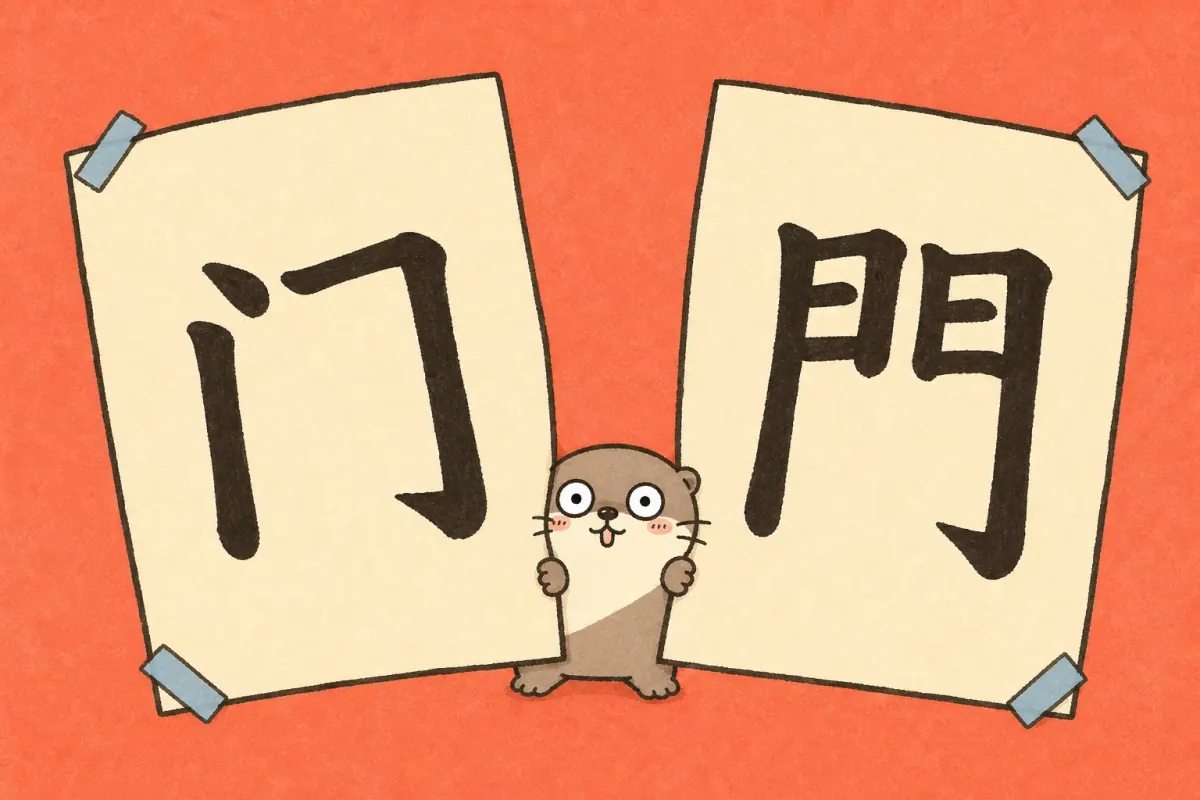
Taiwanese Mandarin and mainland Mandarin are regional varieties of the same language. Speakers can normally understand one another without switching languages. The differences you will notice most are traditional versus simplified characters, a few dozen very common vocabulary choices, and the sound and rhythm of everyday speech.
You do not need to choose the “universally correct” version. Learn the variety used where you plan to live, study, travel, or find entertainment. The core transfers easily, and exposure to the other variety soon makes its recurring differences familiar.
First, “Taiwanese” can mean two different things
Taiwanese Mandarin, often called 台湾华语 (Táiwān Huáyǔ) in teaching contexts, means the Mandarin used in Taiwan. In Taiwan, Mandarin is commonly called 国语 (Guóyǔ, “national language”).
Taiwanese, or 台语 (Táiyǔ), often refers to Taiwanese Hokkien (Taigi). That is a different Sinitic language, not Mandarin with a Taiwanese accent. Taiwan is also home to Hakka, Indigenous languages, and other languages.
In mainland China, standard Mandarin is called 普通话 (Pǔtōnghuà, “common speech”). “Mainland Mandarin” is a broad label: Mandarin in Beijing, Sichuan, Dalian, and Guangdong does not all sound alike. In this article, it means the standard taught in mainland schools and some widespread tendencies in mainland speech—not one accent shared by more than a billion people.
The core language is highly shared
Both standards grew from the same early modern standardization project and share their central grammar, four lexical tones, and an enormous amount of vocabulary. Differences exist in everyday expressions and even some grammatical preferences, but they rarely prevent a conversation between speakers of the standard varieties.
Linguists therefore describe Mandarin as pluricentric: it has more than one recognized regional center. Corpus research finds genuine cross-strait differences in word choice and construction preferences, alongside a large common system (Huang et al., 2014).
For a learner, this means a Taiwan textbook does not trap you in Taiwan, and a mainland course does not make you incomprehensible in Taipei. Your first adjustment will be reading and listening, not relearning Mandarin from zero.
The writing system is the most visible difference
Taiwan normally uses traditional characters; mainland China normally uses simplified characters:
Taiwan: 我想學中文。
Mainland: 我想学中文。
Wǒ xiǎng xué Zhōngwén. — I want to learn Chinese.
This is a difference in writing, not pronunciation. Many characters are identical, and recurring component changes make cross-script recognition easier with practice. Our guide to simplified and traditional Chinese explains how to choose a main script and add the other later.
Script conversion alone is not full regional localization. Taiwan and mainland China sometimes choose different words for the same object, so a sentence can be in traditional characters and still sound unmistakably mainland—or vice versa.
Everyday vocabulary gives you the quickest clues
The same concept may have a different everyday name:
| English | Taiwan | Mainland China |
|---|---|---|
| subway / metro | 捷運 jiéyùn | 地铁 dìtiě |
| taxi | 計程車 jìchéngchē | 出租车 chūzūchē |
| software | 軟體 ruǎntǐ | 软件 ruǎnjiàn |
| video | 影片 yǐngpiàn | 视频 shìpín |
| pineapple | 鳳梨 fènglí | 菠萝 bōluó |
| potato | 馬鈴薯 mǎlíngshǔ | 土豆 tǔdòu |
These pairs matter because they occur in ordinary situations. Ask for the 地铁 in Taipei and you will still be understood, but every station sign says 捷運. A mainland listener will know what 計程車 means, even though 出租车 is the locally expected word.
The differences came from separate institutions, local languages, historical contact, and different translations of new technology and imported concepts. Corpus-based work finds several types: different names for the same thing, the same form used with different meanings, and terms unique to one side’s institutions or daily life (Zhou & Zhou, 2019).
Do not turn the table into a wall of paired flashcards. Learn the word you need now, then store the other as a recognition synonym when you meet it.
The accents are real, but neither region has one accent
Many learners hear a difference before they can name it. Casual Taiwan Mandarin is often perceived as having less strongly curled-back 翘舌音 (qiàoshéyīn)—the sounds written zh, ch, sh, r in pinyin—than carefully articulated standard mainland speech.
That does not mean Taiwan Mandarin simply lacks these sound categories. Speakers vary from a clear contrast to a partial merger with z, c, s, and style matters: someone may distinguish them more carefully while reading or in a formal setting. A 2024 phonetic study describes the Taiwan Mandarin contrast as variably implemented, ranging from merged to clearly distinct productions (Chiu et al., 2024).
Mainland speech also varies enormously. Strong retroflexion is associated especially with northern speech. Southern mainland speakers may use much weaker retroflexion or merge some of the same sounds. Treating a highly Beijing-flavored voice as “the mainland accent” erases more variation than it explains.
Erhua is much less prominent in Taiwan
儿化 (érhuà) adds an -r quality to a syllable. It is especially associated with Beijing and other northern varieties:
这儿 zhèr — here
一点儿 yìdiǎnr — a little
In Taiwan, you are much more likely to hear:
这里 zhèlǐ — here
一点 yìdiǎn — a little
Erhua is not equally common across mainland China either. Standard mainland dictionaries include many -r forms, but how frequently speakers use them depends on region, word, and speaking style. You do not need to add r everywhere to sound “mainland.”
Neutral tone behaves differently in many words
Both varieties have neutral tone, but everyday Taiwan Mandarin often keeps a fuller lexical tone in words that standard mainland pronunciation commonly reduces. The exact difference is word-specific rather than a rule that Taiwan “has no neutral tone.”
Research comparing the phonetic inventories of regional Mandarin varieties identifies both the mainland -r suffix and differences in neutral-tone realization as established points of variation (Li, 2020). Acoustic work on Taiwan Mandarin has also found that its neutral-tone syllables may preserve more duration and phonetic substance than their standard mainland counterparts (Tseng, 2012).
The practical solution is to learn common words from whole recordings. If the Taiwan speaker and mainland speaker give the second syllable different weight, copy the phrase rather than trying to apply a region-wide formula.
A few familiar words have different standard readings
Some written words receive different dictionary pronunciations. The famous example is 垃圾, “trash”:
- Taiwan standard: lèsè
- mainland standard: lājī
Taiwan’s Ministry of Education dictionary lists 垃圾 as lèsè, while mainland-oriented dictionaries list lājī (Taiwan MOE dictionary, Handian).
There are other cross-strait differences in the preferred reading of individual characters and words, but do not expect every Taiwan speaker to follow a dictionary in every casual sentence. Media exposure and movement across the strait create variation, and some people know or use both readings.
Zhuyin and pinyin teach the same Mandarin sounds
Children in Taiwan commonly learn pronunciation through 注音符号 (Zhùyīn Fúhào), usually called Zhuyin or Bopomofo: ㄅㄆㄇㄈ. Mainland schools use 汉语拼音 (Hànyǔ Pīnyīn), which writes sounds with Latin letters.
That changes textbooks, dictionaries, keyboards, and how pronunciation is first explained. It does not mean Taiwan has a separate set of Mandarin syllables. Taiwan’s Ministry of Education describes Zhuyin as a tool for marking pronunciation and organizing dictionary lookup (Taiwan MOE Zhuyin manual).
Foreign learners in Taiwan are often taught pinyin as well. You can speak Taiwan Mandarin with pinyin and mainland Mandarin after learning Zhuyin. The notation system is not the accent.
Are there grammar differences?
Yes, but they are usually tendencies rather than a beginner-level split. Speakers may prefer different word orders, particles, measure words, or conventional ways to make a request. Some Taiwan uses reflect contact with Taiwanese Hokkien; some mainland patterns vary by local language and region too.
Corpus studies have found different preferences in constructions involving 给 (gěi) and in common light verbs, but both varieties still share the relevant grammar (Hsiao & Chen, 2026).
You do not need a separate grammar chart before speaking. If a construction is natural and widely understood in your main variety, use it. As you consume more regional media, you will absorb the alternatives as phrases.
Which Mandarin should you learn?
Learn the variety used by the people, places, and media you care about most; either choice gives you a solid Mandarin base, and recognition of the other can be added later.
Focus on Taiwan Mandarin if…
- you plan to live or study in Taiwan;
- your partner, family, friends, or customers are mainly in Taiwan;
- you want traditional characters and Taiwan-made books, shows, podcasts, or games;
- you want to use Zhuyin or type with a Taiwan keyboard layout.
Focus on mainland standard Mandarin if…
- you plan to live, study, work, or travel mainly in mainland China;
- most of the people you speak with are from the mainland;
- your favorite media and platforms are mainland-based;
- you want simplified characters and the widest range of pinyin-based learning material.
If you have no regional goal
Choose the teacher, course, or content you are most likely to stick with. Consistent exposure matters more than optimizing an accent before you can hold a conversation.
Whichever you choose, hear more than one speaker. Taiwan includes formal broadcasters, Taipei casual speech, central and southern accents, young internet speech, and Mandarin influenced to different degrees by other local languages. Mainland China contains even greater regional range.
How to become comfortable with both
- Keep one active standard. Use one script and one main pronunciation model when producing Chinese.
- Build a small recognition list. Start with transport, food, technology, and daily services: 捷運/地铁, 計程車/出租车, 軟體/软件.
- Watch the same format from both regions. Compare two cooking clips, interviews, or tech reviews. A shared topic makes differences easier to notice.
- Do not imitate stereotypes. Copy a real speaker’s full phrase, rhythm, and context—not a collection of exaggerated r sounds or deliberately flattened consonants.
- Ask for the local word. If someone reformulates your sentence, treat it as a useful synonym rather than evidence that your Mandarin was wrong.
The important outcome is flexibility. You can keep a consistent home variety while understanding people who write, phrase, and pronounce Mandarin a little differently.